Intro to Shadow Work
What Is a Shadow and How Can We Work With It?

Simply put, a shadow is any aspect of ourselves that we naturally suppress or turn away from. It does not have to be negative or stem from early childhood trauma, rather, a shadow can be formed at any time in our lives for any number of reasons.
An example of how a shadow can be born is as follows: a young woman is singing in the shower and her roommate bangs on the door, asking her to quiet down. The woman in the shower may perceive that as “your voice doesn’t sound good and I don’t want to hear you” and convince herself that no one else would want to hear her sing either. This, in turn, could lead to an avoidance of singing in public places in fear of disrupting the peace.
A great exercise for determining one’s shadows is writing on a piece of paper “some of the things that I am not might be...” and allowing the words to flow without taking the time to think. This exercise opens the door to hidden parts of our personality we’ve neatly tucked away. Out of sight, out of mind.
This is where the work begins.

A shadow first comes into existence when we decide not to identify with a certain behavior, trait, or characteristic that we possess. If someone grew up in a large household where they were expected to care for the younger siblings while maintaining a clean environment and neglecting their own needs, a shadow that may have surfaced for them is one of being spontaneous or free. With so many responsibilities at a young age, a person with this history may go on to be quite structured with very little room for error, telling themselves “I have too many responsibilities to be spontaneous and wild”.
Alternatively, someone with the same upbringing may develop quite the opposite shadow. In this instance, out of resentment for the strict parenting they received and an aching desire for freedom, they go on to explore life and break free of the rigidity they despised so much. The shadow that may develop in this scenario is one of responsibility.
Integration
If shadows appear because we deny parts of who we are then the shadow work begins when we are ready to call these parts back home.
We begin to reclaim our own power and rise above the limitations we’ve imposed upon ourselves by integrating our shadows and returning to a place of wholeness. This doesn’t mean saying to ourselves “I’m a liar and a cheat and I wholeheartedly embrace it” but it does mean accepting that we as humans all have the capacity for lying and cheating and understanding that it doesn’t inherently make someone a bad person should they choose to do so. Instead, we might say something along the lines of “I admit that there have been times in my life where I have lied and I may be dishonest many times to come, but I love myself and I accept myself, knowing I am doing my very best”.
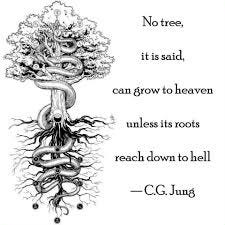
It isn’t easy, this process of integration. It feels foreign, unnatural, as we’ve grown accustomed to avoiding the very thing that we’re being told to call in. It’s akin to that strange sensation that occurs in the body when firmly stating “no more” to old habits, places and environments that no longer align with one’s values.
There’s a transitional period where one may go back to said environment or engage with the habit or hold space with the toxic individual. This is because for a certain period of time, that person, place or thing felt like home. It becomes uncomfortable when we make the conscious decision to enact change in our lives because it’s the first time we’re allowing ourselves to receive something better.
It’s the same with shadows- their entire existence is built around separation so it’s no wonder it feels wrong to reach out our hands and say “here, come with me”. This is precisely why the work is so important.
A Beautiful Process
The beauty of the above mentioned exercise lies in the vast number of shadows we all possess. The journal prompt will bring about the shadows most relevant which leads one into a process of integration. One by one we can welcome these parts of ourselves while getting to the root of where they came from.
Through observation of our triggers we begin to understand why certain things people say or personalities observed in others bring forth varying feelings and sometimes reactions from within. This points to the parts of ourselves that have been shut down, a beautiful opportunity for an inner conversation between the ‘self’ and what the self has suppressed.
Overtime we can come back to said journal prompt and see what surfaces. If there is a deeply rooted shadow it may very well appear again, alongside other words that hadn’t come out to play previously. We’ve all been blessed with a lifelong journey of self-discovery and healing and our shadows play a huge part in it.
“One of the things that I am not might be…”
“Intelligent.” Great, the first step has been taken. From here we navigate a new series of sentence stems. “The first time I remember feeling unintelligent was…” “The reactions I received from those around me were…” “This made me feel…” “When I am in the presence of highly intelligent people I feel…”
There are infinite ways to navigate the integration process but the most important thing to do after becoming aware of a shadow is to take the time to understand it. Where did it come from?
What is its story?
What feelings arise from the arrival of this shadow?
As one gets to know their shadow it can no longer be ignored or repressed because it has been given a spotlight and a name. At this stage it is important that the part of the self that created this shadow feels validated and seen for it is only trying to protect the individual, hence why the separation occurred to begin with. By going back to the moments in time when said individual has not felt smart, a conversation takes place in which one can rewrite that narrative and accept said intelligence as a part of who they are.
How Does One Know If They Have Integrated Their Shadow?
Let’s say there was a child who was naturally charismatic and funny, always laughing and expressing himself and unafraid to take up space. One day, he was at a family dinner party and excused himself to use the restroom. Upon his return he overheard a conversation between his cousins. “He’s so obnoxious, always making everything about him”. “Yeah, I wish he would just shut up”. This occurred when the boy was at an impressional age and the harsh words from his cousins completely shut him down. He exuded his natural Leo energy less and less until he barely participated in group discussions at all, finding himself easily annoyed at those he observed to be “obnoxious” and “arrogant”. Should he choose to open himself to this shadow aspect and slowly integrate it, embracing his natural charm and proudly taking up space, he would no longer be triggered by those who are charismatic as well. Accepting who he is with love and gratitude allows him to accept others as they are without judgement.
If there is no judgement for the self, there can be only loving acceptance for others.
It becomes apparent that each person we meet holds a mirror to our own internal realm. We learn, we grow and those we meet help us do so without even trying because it is simply in our nature. Human connection is such a beautiful gift where our emotions and characteristics dance and our understanding of self expands with each meeting. Life truly is divine.
For further guidance - SoulSelfHealing for a 1:1 healing session.
Love and Blessings,
~Umeya Lynn